
Principal Investigator: Madeline Griffith, MS, Children's Hospital of Philadelphia
Using child volunteers in a sled-simulated pre-crash maneuver, this study aims to:
- characterize kinematics, muscle activity, and seatbelt loads of booster-seated children restrained with a pre-pretensioner seat belt in a sled-simulated pre-crash maneuver; and
- examine differences in outcome measures across different seating postures.
WHAT WAS THE PURPOSE OF THIS PROJECT?
Pre-pretensioners (PPT) are technology that tighten seat belts to reduce the slack before a crash. We have previously studied the effect of PPTs on adult occupants in the front seat, for whom they were primarily designed. This study assessed how well the PPT would work for children seated in belt-positioning booster seats in both optimal and naturalistic postures.
HOW WAS THE RESEARCH CONDUCTED?
We tested eight child volunteers ages 6 and 7 years with and without PPT in a low acceleration (1g) sled-simulated frontal-oblique (30°) impact. Participants were seated in both standard and forward-leaning postures before the impact event started. A 3D motion capture system, EMG (electromyography, a measure of muscle response), and seat belt load cells were used to capture kinematics, muscle activation, and seat belt loads.
WHAT DID YOU FIND?
We found that in both the standard and the forward-leaning postures, the PPT was effective at reducing maximum head and trunk displacements during these low-acceleration events, which is what we had hypothesized. Use of the PPT increased the proportion of the belt force that was carried by the shoulder belt. These findings suggest that the PPT may be an effective safety countermeasure for booster-seated children as well as adults.
HOW ARE THESE RESULTS APPLICABLE TO INDUSTRY MEMBERS?
Child seat manufacturers and vehicle manufacturers will benefit from the data provided in developing new rear-seat safety technology that is safe and effective for pediatric occupants.
WHAT’S NEXT?
We could compare the results from this study with our previous study on the PPT with adult occupants to quantify similarities and differences. Researchers may also want to study the effect of the PPT on children of different ages and restraint types.
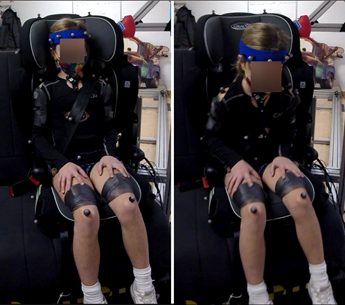
Belt-positioning booster seated child volunteer in standard (left) and forward-leaning (right) postures.

Maximum forward excursion values for the trunk in the standard and forward-leaning postures without the PPT and with the PPT, showing a decrease in maximum excursion with the PPT in both postures.
Co-Investigators
Valentina Graci, PhD, Children’s Hospital of Philadelphia and Drexel University; Thomas Seacrist, MBE, Children’s Hospital of Philadelphia
IAB Mentors
Jonathon Gondek, Calspan Corporation; Emily Thomas, Consumer Reports; Suzanne Johansson, General Motors Holdings LLC; James Fitzpatrick, Graco Children’s Products Inc.; Mark LaPlante, Graco Children’s Products Inc.; Emily Burton, American Honda Motor Co., Inc.; Bill Lanz, American Honda Motor Co., Inc.; Jerry Wang, Humanetics Innovative Solutions Inc.; Russ Davidson, Lear Corporation; Nick Rydberg, Minnesota HealthSolutions; Erin Hutter, National Highway Traffic Safety Administration; Schuyler St. Lawrence, Toyota USA; Julie Kleinert, Technical Advisor; Uwe Meissner, Technical Advisor